Key takeaways
- The feeding guide on the pack is a daily total for an average pet in ideal condition, not a per-meal amount and not a prescription.
- Published calorie ranges are wide on purpose: two dogs of the same weight can sit about a quarter apart depending on activity and metabolism.
- Converting calories into grams needs the energy density from the pack, and weighing beats scooping because kibble density varies between foods.
- Body condition over the next few weeks decides the final portion. Adjust in small steps and recheck.
Start with the pack, and read it correctly
Every complete pet food sold in the EU has to carry feeding instructions. That is set out in Regulation 767/2009, the law that governs how pet food is labelled and marketed, so there is always a published starting point on the bag or the tray.
Two things go wrong when people read it. The first is the timescale: the figure is almost always a daily total, meant to be divided across however many meals you feed. Reading it as a per-meal amount doubles the food for anyone feeding twice a day. The second is which row to use. The table is indexed by body weight, and it assumes that weight is already a healthy one. If your pet is carrying extra weight, the row matching what the scales say today will keep feeding the animal it currently is.
The guide is also built around an average. Manufacturers cannot know whether your dog walks twice a day or spends most of it asleep, so they publish something that works for the middle of the distribution and expect owners to adjust from there. Treating it as an opening bid rather than an instruction is the whole skill.
What the published calorie ranges say
If you want to sanity check the pack against something independent, the World Small Animal Veterinary Association publishes calorie ranges for healthy adult pets in ideal body condition, calculated from the 2006 National Research Council maintenance figures.
Their dog chart puts a 10 kg dog at roughly 470 to 590 kcal a day, a 20 kg dog at 790 to 990, and a 30 kg dog at 1080 to 1350. Notice that doubling the dog does not double the food: the 20 kg figures are about 1.7 times the 10 kg ones, because energy needs track metabolic body weight rather than weight itself. That is why a feeding table cannot be a straight line, and why guessing a big dog's portion by scaling up a small dog's is unreliable.
For cats the published calculation is 100 kcal times body weight in kilograms to the power of 0.67 for a lean adult, and 130 kcal times body weight to the power of 0.4 for a cat prone to putting on weight. That places a 4 kg cat near 225 to 250 kcal a day and a 5 kg cat near 250 to 290.
The width of those ranges is the useful part. Roughly a quarter separates the low end from the high end at the same body weight, which is more variation than most feeding tables imply. WSAVA attaches a plain warning to both charts: the numbers are guidance only, and individual animals need more or less to hold an ideal, trim condition.
Turning calories into grams
A calorie target is not yet a portion. To get there you need the energy density of the specific food, normally printed as kcal per kilogram or per 100 g. Divide the daily target by that density and you have the daily weight of food.
A pet needing 500 kcal a day, eating a food that provides 380 kcal per 100 g, needs about 132 g a day. Swap to a richer food at 420 kcal per 100 g and the same pet needs about 119 g. Nothing about the animal changed, only the food, and the portion moved by more than a tablespoon of kibble.
This is also why switching foods without redoing the sum is one of the more common causes of slow, unexplained weight gain. The old portion looks familiar in the bowl and carries a different number of calories.
If you would rather not do the division at the shelf, our pet food calculator runs the same numbers in both directions.
Weigh the food instead of scooping it
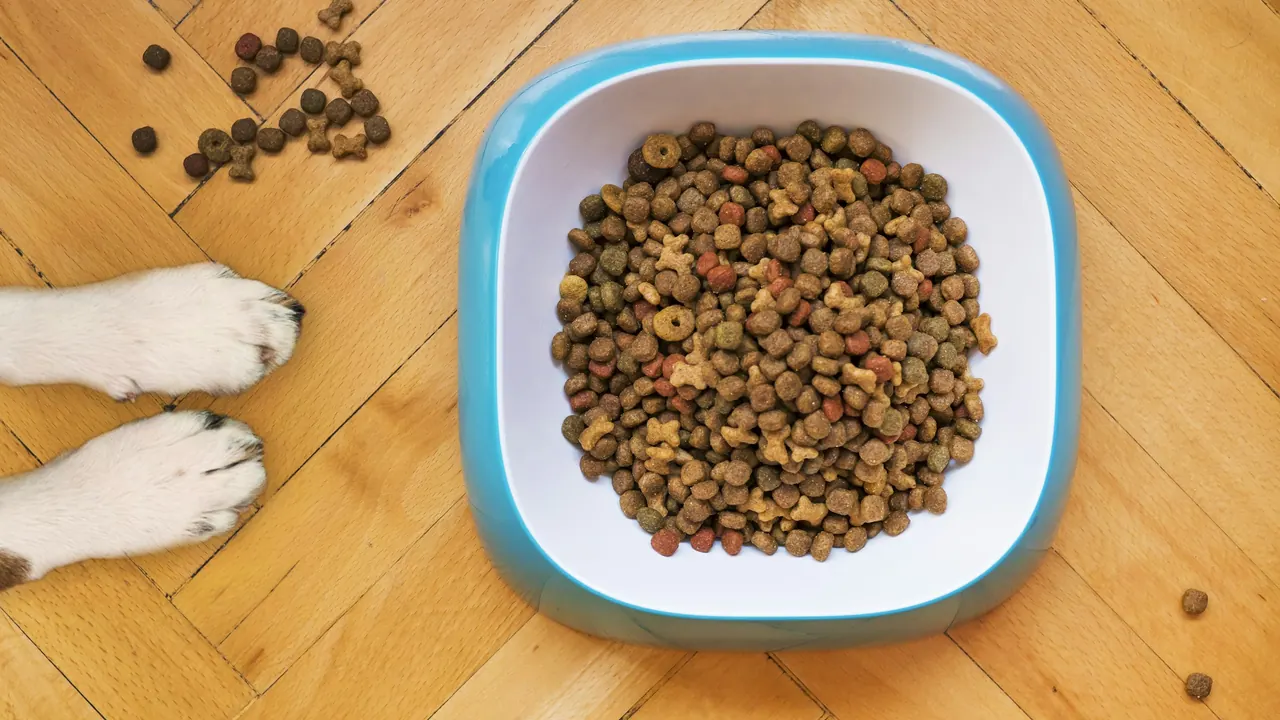
A measuring cup records volume. What matters nutritionally is mass, and the relationship between the two depends on how big the pieces are, what shape they are, and how much fat is on them. Two foods that look similar in the bowl can sit at meaningfully different densities, so a scoop calibrated on the old bag quietly misreports the new one.
A kitchen scale removes the problem for the price of a bag of food. If weighing every meal feels tedious, weigh the correct portion once, tip it into the scoop you already use, and mark the level. You keep the speed of scooping and lose most of the error.
The same logic applies to wet food. A heaped spoonful is not a unit, and trays and pouches vary in size between ranges from the same brand.
Let body condition settle the number
Calorie formulas and feeding tables are both estimates. The animal is the measurement. Body condition scoring is the standard way to read it, usually on a nine point scale where four to five is ideal: ribs easy to feel without pressing, a waist visible from above, and an upward tuck of the belly seen from the side.
Check it every couple of weeks rather than every day, because real change is slow and daily weighing mostly measures gut contents. If the score is drifting in the wrong direction, move the portion by around ten percent and hold it there long enough to see an effect. Halving or doubling food produces hunger, begging and a rebound rather than a stable weight.
Deliberate weight loss is the exception to any do-it-yourself approach. It needs a target weight, a controlled rate of change and monitoring, and both the target and the pace are worth setting with a veterinarian rather than a chart.
Treats and chews are part of the total
Most veterinary nutrition guidance puts a ceiling of about ten percent of daily calories on everything that is not the complete food. The reason is structural: the complete diet is formulated to deliver a full nutrient profile at the intended intake, and every calorie that arrives from elsewhere dilutes it.
Ten percent of 500 kcal is 50 kcal, which is a small budget in practice. A dental chew, a training session with pieces of cheese, and the bit of food used to hide a tablet can spend it between them before dinner. Counting it is not fussiness, it is the difference between a plan and a guess.
- Training rewards, especially during a course of classes when frequency is high.
- Dental chews and long-lasting chews, which are often surprisingly energy dense.
- Food used to give medication.
- Human food offered from the table, which is where portion control usually fails first.
Growth, neutering and older pets
Growing animals need considerably more energy per kilogram than adults, and large breed puppies are a special case: the rate of growth itself matters, not only the total. Overfeeding a large breed puppy is a recognised orthopaedic risk rather than a cosmetic one, which is why growth diets carry their own instructions and why a veterinarian is the right person to steer them.
Neutering lowers maintenance energy needs. The portion, meanwhile, usually stays exactly where it was, and that mismatch explains a lot of the weight gain seen in the months afterwards. It is the clearest moment in most pets' lives to recalculate rather than continue.
Older pets move in both directions. Some become less active and need less; others lose weight and muscle and need more, or need a different food entirely. An unexplained change in weight or appetite in an older animal is a reason to book an appointment, not to adjust the scoop.
Frequently asked questions
How much should I feed my dog each day?
Start with the feeding guide on the pack, read as a daily total, then sanity check it against WSAVA's published ranges for healthy adult dogs: roughly 470 to 590 kcal a day for a 10 kg dog, and 790 to 990 for a 20 kg dog. Body condition over the following weeks decides where in that range your dog actually sits.
How do I convert calories into grams of food?
Divide the daily calorie target by the energy density printed on the pack. At 380 kcal per 100 g, a 500 kcal target works out to about 132 g a day. Without the energy density there is no way to turn calories into a portion.
Is it better to measure pet food by cup or by weight?
By weight. Cups measure volume, and kibble density changes with piece size, shape and fat content, so one scoop is not a fixed amount of food across products. Weighing is the cheapest accuracy gain available.
How much of my pet's daily food can be treats?
About ten percent of daily calories, so the complete food still delivers the nutrient profile it was designed around. On a 500 kcal allowance that is roughly 50 kcal, and chews, training rewards and food used for medication all draw on it.
Should I feed my overweight pet for its current weight or its target weight?
Neither on your own. Guides assume an animal already in ideal condition, so the current weight of an overweight pet keeps feeding that weight. Planned loss needs a target, a safe rate and monitoring, which is a conversation with your veterinarian.